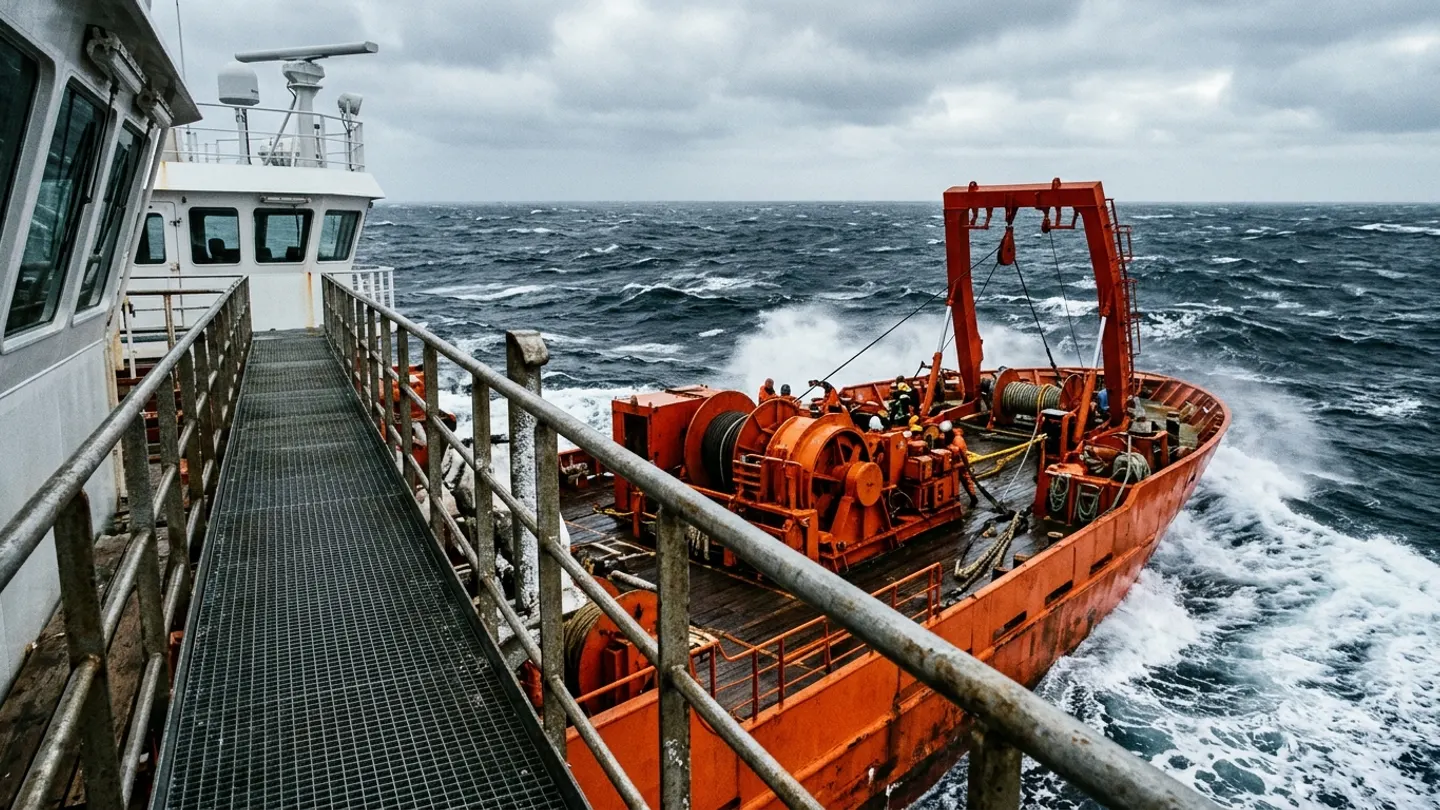
At sixty-nine degrees north, holding a 9,400-tonne repair ship within two meters of a seabed coordinate requires three azimuth thrusters working continuously against four-meter swells. Down on the enclosed main deck, two optical engineers work under surgical microscopes inside a pressurized clean hut, fusing hair-thin glass fibers encased in copper power tubing and galvanized steel armor.
Over fourteen days at sea, our documentary team followed a rapid-response maintenance crew tasked with restoring a dual-armored data link that carries hydrological telemetry, interbank clearing traffic, and university research datasets between mainland Scandinavia and North Atlantic relay stations.
Grappling in four hundred meters of dark water
Before a single fiber can be spliced, deck officers lower a flat-fluked grapnel across the muddy trench where trawl doors or seabed rockslides have crushed the outer polyethylene sheath. Once the faulty segment is winched aboard and capped, optical time-domain reflectometers pinpoint attenuation to within a dozen meters.
The vessel availability crunch revealed during our voyage directly informed the procurement guarantees written into Midnight vote seals the Baltic offshore grid treaty after nine months of deadlock, as energy utilities and telecom consortia now compete for fewer than eighty specialized cable ships worldwide.
Redundancy between seabed and orbit
While satellite operators pitch low-Earth constellations as instant backups for isolated archipelagos, marine engineers point out a sobering capacity gap: a single sixteen-pair subsea trunk transmits more terabits per second than an entire orbital shell—whose own congestion rules are tightening rapidly in Crowded low-Earth shells force insurers and regulators to price orbital lanes.